 Queenstown City Guide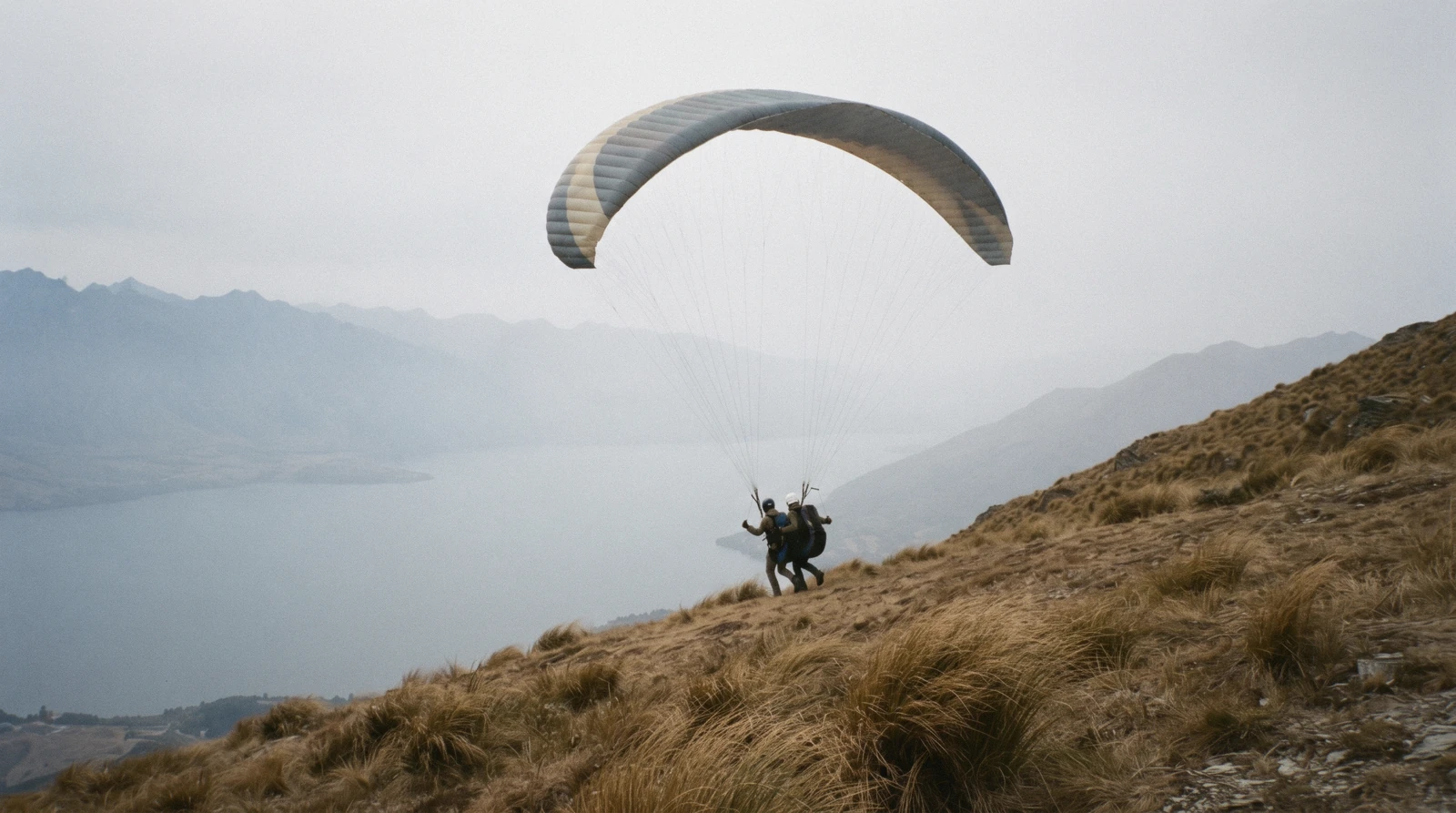
Paragliding in Queenstown, New Zealand
Paragliding: Queenstown sells it as one activity and it is really two. One launches off Coronet Peak, a 20 minute drive north of town, and needs a chairlift in winter. The other launches off Bob's Peak at the top of the gondola and needs a gondola ticket you buy separately. Neither uplift is inside the flight price, both operators publish their own weather rules, and the flight itself lasts 10 to 20 minutes whichever you choose. This page prices both, and sits inside the adventure activities hub with everything else in this basin that leaves the ground. The other ways off Bob's Peak, and everything else in town, start on things to do in Queenstown.
Quick answer The two launch sites, what the uplift adds, and how long you are actually in the air
Two operators fly tandem passengers over Queenstown from two different mountains. Off Coronet Peak, 20 minutes north of town, a summer flight is $215.50 (NZ$369) and the winter launch at 5,400 ft is $233.00 (NZ$399). Off Bob's Peak, at the top of the gondola, the tandem starts at $180.50 (NZ$309). Prices on this site are in US dollars first with the New Zealand dollar in brackets, converted at NZ$1 = $0.584. Air time is 10 to 20 minutes on either mountain, and 15 to 20 minutes on the winter flight.
Key takeaways
- Neither price includes getting to the launch. Bob's Peak needs a gondola ticket from $40.30 (NZ$69), and the winter Coronet Peak launch needs a chairlift pass at $20.40 (NZ$35) bought at check-in. The uplift table puts the real totals side by side.
- The winter Coronet Peak flight buys the longest time in the air, 15 to 20 minutes against an average of 10 to 20, and it is the flight that pays for a snow landing view. Book it against the ski season dates, because the chairlift is what makes it possible.
- The summer tandem listing cancels free up to 24 hours before the start time. The operator's own terms charge 50% inside 48 hours and the full price inside 24, so on this activity the platform booking is the more forgiving one.
- Weight is the hard limit, not age: 120 kg maximum, dropping to 110 kg in April and May, and exceeding it at check-in cancels the flight with no refund. The limits section has the numbers for both operators.
Key facts
Opening hours
| Coronet Peak, summer (October to early May) | 09:00–19:30 |
|---|---|
| Coronet Peak, winter (mid June to September) | 09:00–14:45 |
| Bob's Peak, above the gondola | No departure times published; the operator asks flyers to check the flight status 30 minutes before their booked time |
Closed None published. Wind, not the calendar, closes this activity, and both operators post a daily flight status instead of opening hours
Admission
- Adult
- Bob's Peak tandem from $180.50 (NZ$309), Coronet Peak summer tandem $215.50 (NZ$369), Coronet Peak winter tandem $233.00 (NZ$399), none of them including the uplift
- Reduced
- No child fare is published for either flight. One operator states it has no age restriction; the other publishes none, and both enforce weight instead
- Free
- Spectators ride the shuttle free when there is room, and can otherwise drive to the landing field at Flight Park on Malaghans Road and watch from the ground
Planning it
- Time needed
- About 2 hours in summer and 2.5 hours in winter from check-in to being back in town, of which 10 to 20 minutes is flight
- Book ahead
- Recommended — a few days
- Address
- Check-in for the Coronet Peak flights is 45 Camp Street, inside the Ziptrek Ecotours store, central Queenstown. The Bob's Peak operator checks in at the top of the Skyline Gondola
Three tandem flights from two launch sites, priced from skytrek.co.nz, the GForce booking catalogue and the platform listings on in Q3 2026. The operator's own page is the first row and its link carries no tracking. US dollar figures are converted at NZ$1 = $0.584, and all three operators publish in New Zealand dollars.
The flight prices are close. The uplift, the season and the cancellation terms are what actually separate these three.
| Flight | Price | Launch | Air time | What it settles | Book |
|---|---|---|---|---|---|
| SkyTrek, booked directAnyone who wants to choose summer or winter launch directly, or to swap a paraglider for a hang glider at the same price | $215.50 (NZ$369) summer, $233.00 (NZ$399) winter | Coronet Peak, 4,100 ft in summer and 5,400 ft in winter | 10 to 20 minutes, 15 to 20 in winter | The operator's own flight status page, free transport from town, and hang gliding as an alternative at the same price | Official site |
| Tandem paragliding on the platform listingFirst-time flyers who want a cancellation window better than the operator's own, and the media question settled at booking | $215.99 | Coronet Peak, with transfers from Camp Street | About 90 minutes door to door | Free cancellation up to 24 hours ahead, and photos and videos named in the inclusions | Check Availability |
| Winter tandem from Coronet Peak, 5,400 ftWinter visitors, and anyone who would rather launch off snow at the highest lift-served site than off tussock in summer | $233.55 | The top of the Coronet Peak ski field, reached by chairlift | About 2 hours door to door | The longest time in the air of the three, plus a chairlift pass buyable at check-in for NZ$35 | Check Availability |
A fourth flight exists and does not appear as a row because there is no listing to link: GForce is the only company permitted to fly from Bob's Peak, above the gondola, and sells its tandem direct from $180.50 (NZ$309). Its untracked booking page is linked in the uplift section, and the gondola ticket it requires is not in that figure.
Tandem Paragliding in Queenstown: Summer and Winter Compared
Two bookable flights off the same mountain in two different seasons. Prices are the platform listings in US dollars, and each card links to the operator's live calendar where the day's departure times sit.
 from $215.99
Most booked
from $215.99
Most booked
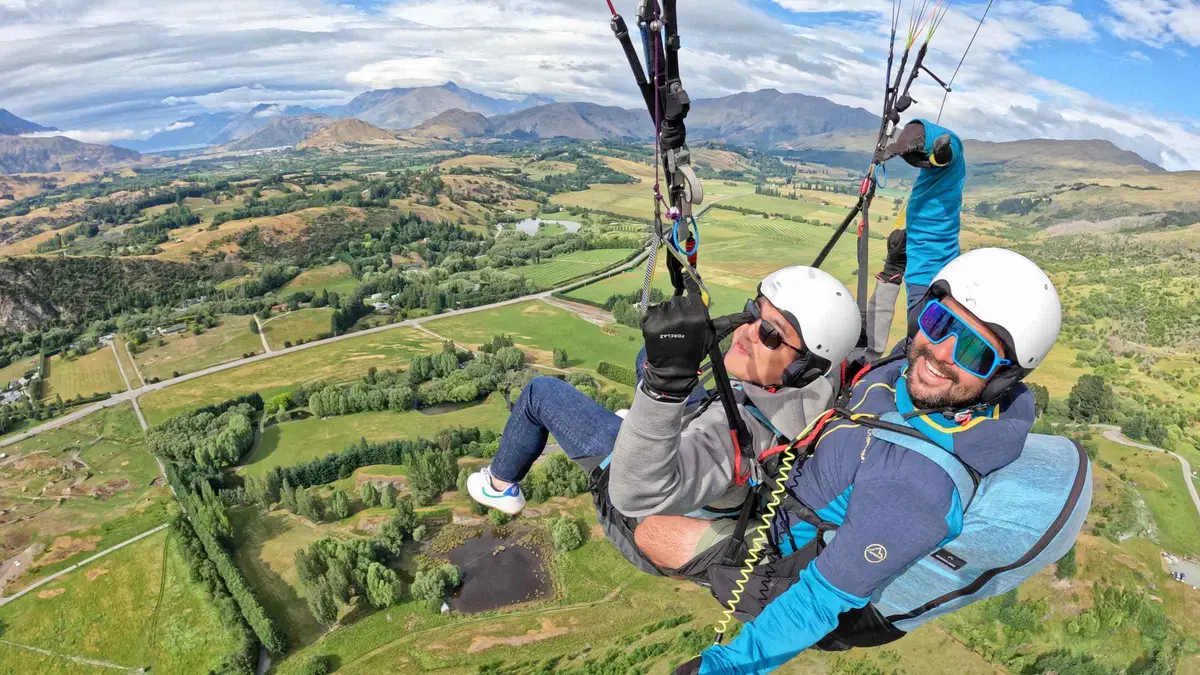
Queenstown: Tandem Paragliding Experience
The standard tandem flight, launched off Coronet Peak with transfers from Camp Street and the photos and video handed over afterwards. About 90 minutes in total, most of it spent getting up the hill.
Check Availability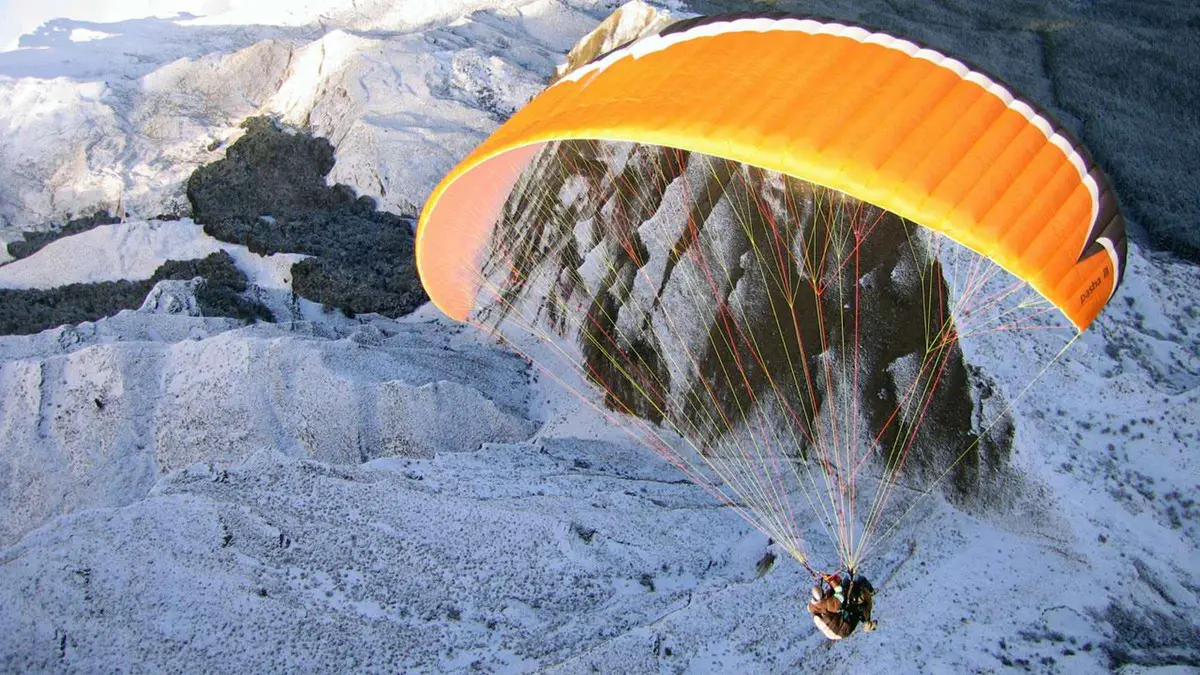 from $233.55
Queenstown: Tandem Paraglide - Winter - Coronet Peak 5400ft
The winter flight, launched from 5,400 feet, the highest commercial site in New Zealand, which buys the longest time in the air. A ski-field pass is needed to reach take-off and can be bought at check-in.
Check AvailabilityBoth flights check in at 45 Camp Street inside the Ziptrek Ecotours store, and both land at Flight Park on Malaghans Road rather than where they took off.
Prices, ratings and details are the platform's own. Dollar figures are the listed prices. The platform bills in your account's currency.
The Ticket That Is Never in the Price: Getting to the Launch
Paragliding is the one Queenstown activity where the advertised price reliably understates the cost, because on both mountains somebody else owns the way up. Figures below are from the operators' own pages and from the Skyline and NZSki price lists.
Off Bob's Peak, the flight begins at the top of the Skyline Gondola and the operator states plainly that a gondola pass is not included; passes are bought at the Skyline terminal on the day of the flight. That is $40.30 (NZ$69) for an adult, and it is a real cost, not a technicality, because there is no other practical way up.
Off Coronet Peak in winter, the take-off is only reachable by the ski chairlift. The operator sells a chairlift pass at check-in for NZ$35 to anyone who does not already hold a ski pass, which is $20.40. In summer the same operator drives you to a launch at 4,100 ft and there is no lift at all, which is the quiet reason the summer flight is the cheaper day out even though the flight itself costs more than the gondola-side one.
| Flight | Flight price | Uplift you must add | Real total |
|---|---|---|---|
| Bob's Peak tandem, above the gondola | $180.50 (NZ$309) | Gondola pass, adult $40.30 (NZ$69), bought at the Skyline terminal on the day | $220.80 (NZ$378) |
| Coronet Peak, summer launch at 4,100 ft | $215.50 (NZ$369) | Nothing. Free transport from Camp Street and no lift in the chain | $215.50 (NZ$369) |
| Coronet Peak, winter launch at 5,400 ft | $233.00 (NZ$399) | Chairlift pass $20.40 (NZ$35) at check-in, or your own ski pass | $253.50 (NZ$434) |
| Winter flight on a day you are already skiing | $233.00 (NZ$399) | Nothing extra. A Coronet Peak day pass at $105.10 (NZ$180) already covers the lift | $233.00 (NZ$399) on top of the ski day |
Which of the four we would book
The summer Coronet Peak flight, on price honesty alone. It is the only one of the four with no second ticket attached, the transport from town is free, and at $215.50 (NZ$369) it is within five dollars of the gondola-side flight once that gondola ticket is paid for.
The exception is a ski day. If you already hold a Coronet Peak pass, the winter launch is the best value flight in Queenstown: the longest air time, the highest lift-served take-off, and the uplift already bought. The Coronet Peak page has the pass prices and the season dates that decide whether this is even on the table.
Where you land is not where you took off
This trips people up more than the uplift does. Flights from Coronet Peak land at Flight Park, 793 Malaghans Road, and the operator's van meets you there with anything you left behind at check-in. If you self-drive to the mountain, your car is still at the top and you need somebody else to bring it down, which the operator says outright.
Self-drive meeting points, if you insist: Carpark 4 on Coronet Peak Road between October and May, and the Coronet Peak base building between June and September. For everyone else the free shuttle from 45 Camp Street is the sane option, and getting around Queenstown covers the alternatives if you are staying out of the centre.
Two Launches, Two Seasons, One Contradiction
The same operator runs both Coronet Peak flights and describes each of them as New Zealand's highest commercial launch site. Both claims are on its own pages, and the difference is worth understanding before you book.
The summer page describes the flight as leaving from New Zealand's highest commercial launch site, 4,100 ft up Coronet Peak, available October to early May. The winter page describes the flight as leaving from the top of Coronet Peak at 5,400 ft, available mid June to September, and the platform listing for it repeats the highest commercial launch line at that higher figure.
Both cannot be the highest. The most likely reading is that the summer site is the highest launch reachable by road, while the winter site is higher and only reachable when the chairlift is running. We could not find a page on which the operator reconciles the two, and we are not going to invent a reconciliation, so treat the phrase as marketing and the altitudes as the fact: 4,100 ft in summer, 5,400 ft in winter.
What the season really changes
Air time. In winter the operator states 15 to 20 minutes; the rest of the year it gives an average of 10 to 20. That is the honest case for the winter flight, and it is a better case than the snow scenery, because the scenery is available from every other lookout in this town for nothing.
The day is longer in summer and shorter in winter, which is the opposite of what most people assume. Summer departures run every 90 minutes from 09:00 to 19:30. Winter departures run every two hours from 09:00 to 14:45, because the chairlift closes at 16:00 and the flight has to be off the mountain before it does. So a winter flight has five or six slots a day against summer's eight, and the door-to-door block goes up from about two hours to about two and a half.
The winter window depends on a ski field opening
Mid June to September is the operator's stated window and it maps onto the ski season rather than the weather. For 2026 Coronet Peak's published season runs 13 June to 4 October, so the flight's window opens when the chairlift does and closes before the field does. A late opening moves it.
Between early May and mid June, and again between the end of September and October, neither the summer nor the winter flight is scheduled. If your dates fall in those gaps, the Bob's Peak operator flies year-round from the gondola instead, weather permitting, and our winter page has what else is and is not running in the shoulder.
Wind, Flight Status and What Cancels a Flight
Paragliding is the most weather-sensitive activity sold in Queenstown, and both operators handle that with the same mechanism: a daily flight status, not a forecast. Here is how each of them words it.
SkyTrek publishes a Flight Status line on its own home page, generally updated each morning before 08:00 and again during the day if conditions change, and tells customers to check it an hour before their check-in time. GForce asks flyers to check its flight status 30 minutes before the scheduled flight. Both were displaying a live status, one flying and one closed, which is a fair illustration of how local this call is: two mountains, ten kilometres apart, two different answers on the same morning.
What neither publishes is a threshold. No wind speed, no gust limit, no cloud base, no direction that grounds a launch. We read every public page on both sites looking for one and there is none. That is normal for the sport and unhelpful for planning, and it means the only reliable protection is a flexible booking and a spare day. Since the only reliable protection is a flexible booking and a spare day, that spare day is a natural slot for one of the best tours in Queenstown, guided or private, half day or longer.
The cancellation terms are where the operators and the platforms diverge
This is the single most useful thing on this page for anyone booking from overseas. SkyTrek's own policy is 48 hours: cancel more than 48 hours ahead and there is no fee, cancel between 48 and 24 hours and you pay 50%, cancel inside 24 hours and you pay the full price. Both platform listings on this page cancel free up to 24 hours before the start time.
So the platform booking is the more forgiving one on this activity, which is the reverse of the usual advice. There is one exception that no booking route protects you from: if you exceed the maximum weight at check-in, the flight is cancelled and no refund is given. That is the operator's stated policy and it is worth reading twice before booking for somebody else.
| When you cancel | Booked direct with the operator | Booked on the platform |
|---|---|---|
| More than 48 hours ahead | No fee | No fee |
| Between 48 and 24 hours ahead | 50% of the price | No fee |
| Inside 24 hours | Full price charged | Full price charged |
| Over the weight limit at check-in | Flight cancelled, no refund | Flight cancelled, no refund |
What the operator does when it grounds you
Neither company publishes a written weather-cancellation policy of the kind the local skydive operator prints. What both do is post the status early and rebook, and both keep spare slots through the day for exactly that. The practical consequence: a flight booked for the morning has the rest of the day behind it, and a flight booked for the last slot has nothing.
That is the same advice the adventure sector gives across this basin, and it is why our skydiving page recommends the first available morning of a trip. Do the same here, and keep the flight off your final day.
Weight, Age and Who Cannot Fly
Age barely matters in this sport and weight decides everything. Both operators' published limits.
SkyTrek states a strict maximum of 120 kg for paragliding, dropping to 110 kg during April and May, and 100 kg for hang gliding, dropping to 90 kg in the same two months. The maximum includes footwear and clothing, and the operator says that exceeding it at check-in cancels the flight with no refund. The seasonal drop is not arbitrary: it is the time of year when the air is least helpful to a heavily loaded wing.
GForce, on Bob's Peak, publishes a range rather than a ceiling, 20 to 100 kg, and says it varies with fitness and weather. It also states that it has no age restrictions at all, which is unusual in this town and is the reason it comes up in family searches. Neither operator publishes a minimum age in years.
- Coronet Peak paragliding: maximum 120 kg, and 110 kg in April and May, clothing and shoes included.
- Coronet Peak hang gliding: maximum 100 kg, and 90 kg in April and May, at the same price as a paraglide.
- Bob's Peak paragliding: 20 to 100 kg, varying with fitness and conditions, and no stated age restriction.
- Exceeding the limit at check-in: flight cancelled, no refund, on the operator's own wording.
- Footwear with ankle support is required for take-off, on both mountains, in every season.
- Small action cameras can be chest-mounted for tandem paragliding, which is the opposite of the rule on a tandem skydive.
The camera rule that goes the other way
Worth flagging because it catches people who have already booked a skydive. On a tandem skydive here, cameras of every kind are banned in the aircraft under a national safety requirement. On a tandem paraglide, small chest-mounted action cameras are allowed, and photos and videos are also sold by the pilot after landing.
If you want footage of one adrenaline activity in Queenstown and are choosing where to spend the money, that asymmetry is a real argument for the paraglide: you can shoot it yourself. The skydiving page has the ban in the operator's own words and what its media packages cost as a result.
Paragliding, hang gliding and the parasailing question
Three different things and the search engines conflate them. A paraglider is a soft canopy launched on foot from a mountain, with pilot and passenger seated. A hang glider is a rigid wing, flown lying down side by side, launched with a short run and landed on wheels; the same operator sells it from Coronet Peak at the same price, and offers a combo if you cannot choose. Parasailing is neither: it is a canopy towed behind a boat, and no operator we read sells it in Queenstown.
Both operators also offer some acrobatics at the end of the flight, described as being like a roller coaster, and both make it optional. It is worth saying so to nervous flyers, because the videos that circulate are all of the spirals.
Booking a Queenstown Paraglide: What to Do and What to Skip
Six things worth deciding before check-in, and six you can stop worrying about.
Do
- Add the uplift to the flight price before you compare, using the totals table, because neither operator includes it.
- Take a morning slot early in the trip, and keep the last day free, because the flight status is posted daily and the day has spare slots behind a morning booking.
- Weigh yourself in the clothes and shoes you will fly in, since the maximum includes both and exceeding it at check-in forfeits the fare.
- Book through the platform if your dates might move, because it cancels free at 24 hours where the operator charges 50% at 48.
- Bring your phone to check-in, which the operator requires, plus a card if you want the photo and video package after landing.
- Take the winter flight if you already hold a ski pass for Coronet Peak, which turns the most expensive flight into the best value one.
Don't
- Do not self-drive to the mountain unless somebody else can bring your car down, because you land at Flight Park on Malaghans Road, not at the launch.
- Do not expect a published wind limit. Neither operator prints a speed, a gust figure or a cloud base, and the call is made on the morning.
- Do not book the winter flight for late afternoon. Departures stop at 14:45 because the chairlift closes at 16:00.
- Do not confuse this with parasailing, which is towed behind a boat and is not sold in Queenstown by any operator we read.
- Do not assume the flight is long. Air time is 10 to 20 minutes, and 15 to 20 on the winter launch; the rest of the block is transport and waiting.
- Do not bring one heavy jacket. You will be sitting still in moving air for 20 minutes, and the operator recommends dressing warmly in any season.
Rules and figures above are from skytrek.co.nz, its FAQ page, and nzgforce.com.
Five Things Most Visitors Do Not Know About Paragliding in Queenstown
Each of these came off an operator or government page rather than a brochure, and each carries its source in brackets.
The evidence layer of this page. If a line here changes your booking, the bracket says whose page to read.
- Only one company is permitted to fly from Bob's Peak, and it is named as such by the gondola operator itself rather than claiming it. It has flown in Queenstown since 1991. (Skyline Queenstown, other activities page; nzgforce.com)
- The winter take-off on Coronet Peak is reachable only by the ski chairlift, and a pass costs NZ$35 at check-in if you do not have your own. (SkyTrek FAQ)
- The operator's own cancellation terms are stricter than the booking platform's: 50% inside 48 hours, where the platform is free until 24. (SkyTrek FAQ; the platform listings)
- Exceeding the maximum weight at check-in cancels the flight with no refund, and the limit includes your clothes and shoes. (SkyTrek FAQ)
- No New Zealand authority publishes a tandem paragliding fatality rate, which is the question the search results ask most often. What does exist is the WorkSafe adventure activity register, where every commercial operator must appear as Current after passing an independent safety audit, searchable by name before you book. (WorkSafe adventure activities public register)
Paragliding in Queenstown: Check-in, Launches and the Landing Field
Where each flight starts, where it ends, and how far apart the two mountains are. Neither operator publishes launch coordinates, so the mountain pins sit on the published ski area and gondola locations.
The Flight Park pin is indicative from its road address; the Coronet Peak and Skyline coordinates are from OpenStreetMap and the Skyline address in our facts pack.
What Else Fits Around a Flight
Two hours in summer, two and a half in winter, and one of them is a mountain you have already paid to be on top of. Times are from the Camp Street check-in.
Skyline Gondola and Bob's Peak
The other launch mountain, and the one you can visit without flying off it. The gondola is $40.30 (NZ$69) for an adult and the same ticket is what the Bob's Peak tandem requires. Prices and the luge packages.
Six minutes' walk to the base terminal on Brecon StreetCoronet Peak
The mountain both Coronet flights launch from, and the reason the winter one costs more. If you are already skiing it, the chairlift pass in the flight price disappears. Season dates and lift prices.
About 20 minutes' drive north of QueenstownSkydiving over the Wakatipu Basin
The other way to be in the air here, and the opposite trade: 25 to 60 seconds of freefall from $209.70 (NZ$359), with cameras banned. The altitude and media comparison is the one to read before choosing between the two.
Two minutes' walk to the skydive check-in on Shotover StreetParagliding in Queenstown: Questions
How much does paragliding in Queenstown cost?
The tandem flight itself runs from $180.50 (NZ$309) off Bob's Peak to $215.50 (NZ$369) for the summer Coronet Peak launch and $233.00 (NZ$399) for the winter one, with the platform listings at $215.99 and $233.55. None of those includes the uplift: a gondola pass at $40.30 (NZ$69) for Bob's Peak, or a chairlift pass at $20.40 (NZ$35) at check-in for the winter launch. The uplift table prints the real totals, which run from $215.50 to $253.40.
Do I need a gondola ticket to go paragliding in Queenstown?
Only for the Bob's Peak flight. That operator launches from the top of the Skyline Gondola and states that its price does not include a gondola pass, which is bought at the Skyline terminal on the day of the flight, from $40.30 (NZ$69) for an adult. The Coronet Peak flights need no gondola at all: in summer a free shuttle from 45 Camp Street drives you to a 4,100 ft launch, and in winter the ski chairlift replaces the gondola, at NZ$35 bought at check-in.
How long are you in the air on a Queenstown tandem paraglide?
Ten to twenty minutes on an average flight, and fifteen to twenty on the winter launch from 5,400 ft, which is the honest reason that flight costs more. Door to door the block is about two hours in summer and two and a half in winter, so most of what you are booking is transport, gearing up and waiting for the pilot's call on conditions. The seasons section sets out why the winter day is longer and the winter schedule shorter.
What is the weight limit for tandem paragliding in Queenstown?
The Coronet Peak operator states a strict maximum of 120 kg, falling to 110 kg during April and May, and it includes your clothing and footwear. Exceeding it at check-in cancels the flight with no refund, which no booking route protects you from. Hang gliding with the same operator is capped lower, at 100 kg and 90 kg in those two months. The Bob's Peak operator publishes a range of 20 to 100 kg, varying with fitness and weather, and states that it has no age restriction.
What happens if the wind cancels my paragliding flight?
Both operators post a daily flight status rather than a forecast. One updates it each morning before 08:00 and asks you to check an hour before check-in; the other asks for a check 30 minutes before the booked time. Neither publishes a wind speed, gust limit or cloud base at which a launch is grounded, so the only real protection is booking a morning slot early in the trip with the day's later slots behind it, and holding a fare you can move. The cancellation table shows where the operator's terms and the platform's diverge.
Can I go parasailing in Queenstown instead?
No operator we read sells parasailing in Queenstown, and the two things are often confused. Parasailing is a canopy towed behind a boat with the passenger winched up and down. What Queenstown sells is foot-launched flight from a mountain: paragliding, where pilot and passenger sit under a soft canopy, and hang gliding, where you fly prone under a rigid wing and land on wheels. The same Coronet Peak operator sells both at the same price and will price a combination if you cannot choose.
Is paragliding in Queenstown safe, and who regulates it?
No New Zealand authority publishes a tandem paragliding fatality rate, which is the question the search results return most often, so nothing of the sort is printed here. What is published is the WorkSafe adventure activity operator register: commercial adventure operators must be registered, registration requires passing an independent safety audit, and the public register is searchable by operator name and shows whether a registration is Current, Suspended or Cancelled. Separately, ACC covers treatment for anyone injured in an accident in New Zealand regardless of residency, though not repatriation. Our safety page has both with their links.
Can I bring my own camera on a tandem paraglide?
Yes. The Coronet Peak operator allows small action cameras to be chest-mounted for tandem paragliding, and pilots also sell photo and video packages after landing, bought with your own card at the landing field. This is the opposite of the rule on a tandem skydive here, where cameras of every kind including smart glasses are banned in the aircraft. If footage matters and the budget only stretches to one flying activity, that difference is worth weighing.
Tandem Paragliding over Queenstown on Film
Three flights over the same basin, useful for judging what 15 minutes in a harness looks like and how the launch run actually goes.
Queenstown Must-Do: SkyTrek Paragliding + My Honest Review on Nerves
A Coronet Peak flight with the nervous half of the experience left in, which most flight videos edit out.
Video: Rose's CornerWe DID NOT expect this! Paragliding in Queenstown New Zealand
Launch, flight and landing at length, including the part where the canopy comes up behind you.
Video: TravelKiwiG Force Paragliding Queenstown, New Zealand
The Bob's Peak side of the choice, launched from the top of the gondola rather than off Coronet Peak.
Video: Le One Travel PhotographyVideos load from YouTube only when you press play.
Prices, hours and terms are set by the venue or operator and confirmed at checkout.
We may earn a commission if you book through one of our links, at no extra cost to you. Full affiliate disclosure