 Queenstown City Guide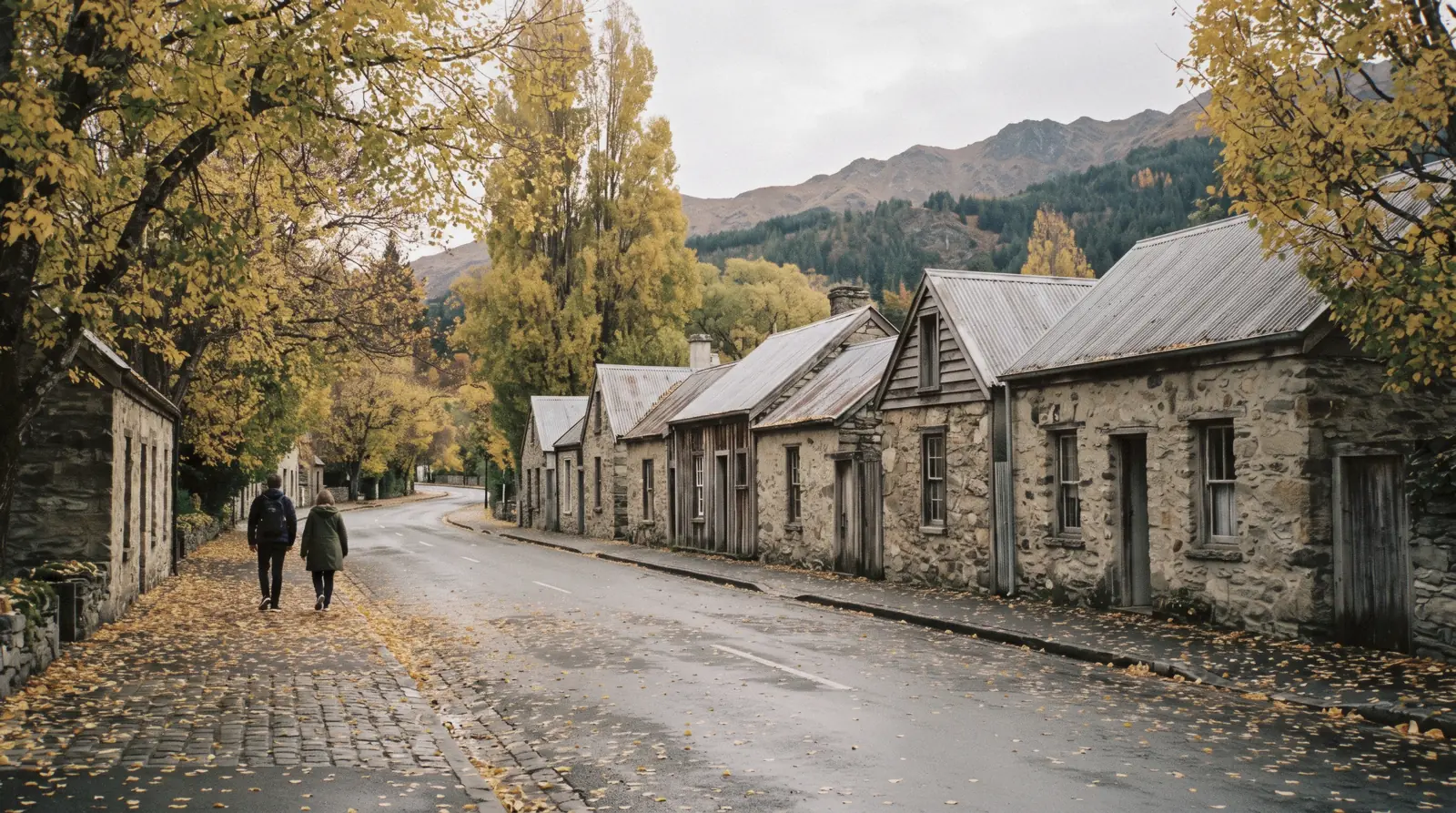
Arrowtown, New Zealand
Arrowtown, New Zealand is a gold town that never got knocked down. The Department of Conservation puts it 20 km north of Queenstown off State Highway 6, and what survives is a single walkable street of 1870s cottages, a partly restored Chinese settlement on the creek behind it, a river you can still legally pan, and a museum that has held the town's records since 1955. This page carries the museum's own hours and prices, what the Chinese Settlement actually was and why it sits where it does, the autumn fortnight everyone comes for, and the two ways back to Queenstown that are not a rental car. It sits inside the day trips hub; the buses and the trail network are on getting around Queenstown. The rest of the basin, town by town, plus things to do in Queenstown, is covered in our city guide.
Quick answer How to get there, what the museum costs, how long the town takes
Arrowtown is 20 km north of Queenstown off State Highway 6, per the Department of Conservation, and two Orbus routes run to it: Route 2 from Frankton Hub and Route 4 from Jacks Point via Queenstown, at $1.46 (NZ$2.50) a ride with a Bee Card. The town is one historic street, a museum, a Chinese settlement on the creek and a river, and three hours covers all four at a walking pace.
Key takeaways
- The Lakes District Museum opens every day 9:00 to 17:00 and closes only on Christmas Day, which makes Arrowtown the reliable wet-weather day trip; its prices and the gold panning start at $8.18 (NZ$14).
- The Chinese Settlement is a Tohu Whenua heritage site with no gate and no published fee, and its main dray track is suitable for wheelchairs and buggies from the entrance to the western end.
- Autumn is the peak fortnight: the Arrowtown Autumn Festival runs 15 to 18 April 2027, and April averages a daily high of 13.7 degrees Celsius against May's 9.7.
- You can ride back instead of driving: the shuttle-out, cycle-back day covers the 35 km on the Queenstown Trails network, and the trails section has the segment distances the operator's figure is built from.
Key facts
Opening hours
| Museum, gallery and archives, daily | 09:00–17:00 |
|---|---|
| Information centre and retail shop, daily | 09:00–17:00 |
| Post office, Mon-Fri | 09:30–16:00 |
| Gold panning lessons, December to February | 10:00–15:00 |
Closed Christmas Day only, for the museum, gallery, information centre and post office. The post office also opens 11:00 to 15:00 at weekends from October to April and not at all at weekends the rest of the year
Admission
- Adult
- Museum $8.18 (NZ$14); senior 65 and over $7.01 (NZ$12); tertiary student $5.84 (NZ$10)
- Reduced
- School-age child $3.50 (NZ$6); family of two adults and three children $17.52 (NZ$30); gold panning lesson $20.40 (NZ$35) adult, including museum entry
- Free
- Children under 5 at the museum. The Chinese Settlement publishes no admission fee, and the streets, the river and the trails cost nothing
Planning it
- Time needed
- Not stated by the museum. Our routing: 3 hours for the street, the settlement and the museum; a full day if you pan, walk the river or ride back to Queenstown
- Book ahead
- Optional — walk-up usually fine
- Address
- Lakes District Museum and Gallery, 49 Buckingham Street, Arrowtown 9302; the Chinese Settlement is at the top end of the same street, on Bush Creek
Four ways to spend money in Arrowtown, read from lakesdistrictmuseum.nz, doc.govt.nz and the GetYourGuide listing on in Q3 2026. Prices on this site are United States dollars first with New Zealand dollars in brackets at NZ$1 = $0.584; the tour card is listed in US dollars by the platform. The first row is the museum's own shop and its link carries no tracking.
Is the money going on the museum, on the panning, or on the ride home? Almost everything in Arrowtown is free to walk, so the only real choices are the museum door and how you leave.
| Option | Price | What it covers | Rule | Book |
|---|---|---|---|---|
| Lakes District Museum and Gallery, at the doorAnyone who wants the town explained before walking it. Under-5s go free | $8.18 (NZ$14) adult; $3.50 (NZ$6) child; $7.01 (NZ$12) senior; $17.52 (NZ$30) family | The museum, the gallery, the archives and the district collection, including finds from the 1983 Chinese Settlement excavation | No booking for general admission; open daily 9:00 to 17:00, closed Christmas Day | Official site |
| Gold panning: lesson, or pan hireFamilies. The lesson guarantees a find; the hire explicitly does not | Lesson $20.40 (NZ$35) adult, $14.60 (NZ$25) child, $57.80 (NZ$99) family; pan and trowel hire $2.92 (NZ$5) | The lesson is 20 minutes, includes museum entry and a guaranteed find of gold to keep; the hire is a pan, a trowel, an instruction sheet and a video | Lessons December to February, 10:00 to 15:00. Hire runs all year, last hire an hour before closing, deposit or ID held | Official site |
| Arrowtown Chinese SettlementEveryone. DOC lists no admission charge but never uses the word free, so we do not either | No fee published | The restored 1880s settlement on Bush Creek, Ah Lum's store, interpretation panels in English and Chinese | Open access, at your leisure, no stated hours; dogs on a leash only | Official site |
| Shuttle to Arrowtown, ride the 35 km backAnyone who wants the town and the trail in one day without a rental car | $61.46 | One-way shuttle from Queenstown, bike or e-bike, helmet, map, briefing, food and drinks | Free cancellation up to 24 hours before; five hours at your own pace | Check Availability |
The museum is the only place in Arrowtown with a turnstile, and at $8.18 it is the cheapest paid attraction anywhere in this guide. Note the panning split, because it decides which one a family should buy: the summer lesson costs $20.40 and guarantees gold to take home, while the year-round pan hire costs $2.92 and guarantees nothing at all.
The ride back from Arrowtown
One card, because one operator sells the trip this page recommends: shuttle out, ride back. Price, rating and duration are the operator's own and are confirmed at checkout.
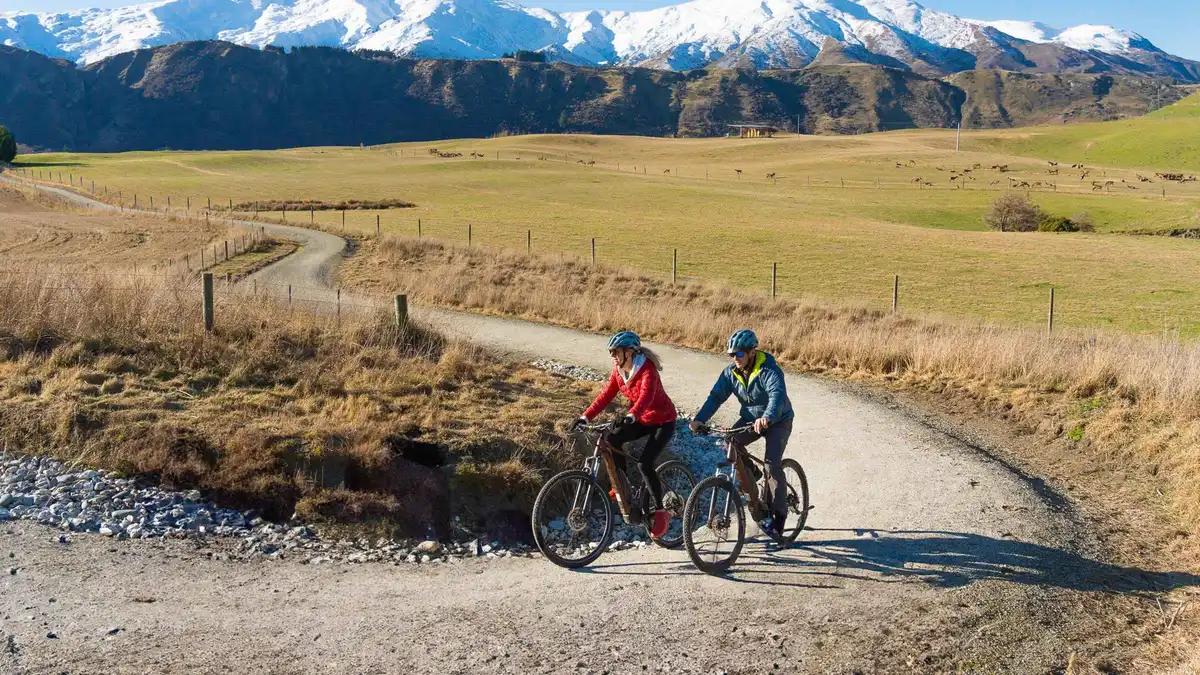 from $61.46
Queenstown: Arrowtown To Queenstown Biking Adventure
A one-way ride: the shuttle carries you and the bike out, then you pedal the 35 kilometres back along the rivers and lake edge into town. Five hours at an easy pace, standard bike or e-bike, ridden unguided.
Check AvailabilityPrices, ratings and details are the platform's own. Dollar figures are the listed prices. The platform bills in your account's currency.
Buckingham Street: what is actually old
The street is the attraction, and it is smaller and more specific than the postcards suggest. Heritage New Zealand has listed exactly which part of it.
The protected stretch is the Buckingham Street Historic Area, Heritage New Zealand list number 7071: seven buildings running from the Stone Cottage Tearooms to 65 Buckingham Street, all built in the 1870s and described by the listing as plain, functional and cheap to erect, which is what miners' accommodation was. Heritage New Zealand calls it an uninterrupted 1870s streetscape lined with historic trees, and that is the sentence to hold on to, because the rest of Buckingham Street is a working shopping street with newer buildings in an older idiom.
Walking it takes ten minutes. Doing it properly takes an hour, because the cottages are set back behind their own front gardens and the interesting side of the town is the lane behind them, where the Arrow River runs. The museum sits at 49 Buckingham Street in the former Bank of New Zealand building, which it moved into in 1955.
We are not naming cafes or restaurants on this page. Arrowtown's food scene is real and the regional tourism body describes it at length, but no citable list, guide or authority ranks it, and a name printed on nobody's authority is worth nothing to you. Walk the street and pick; the two blocks between the museum and the top end hold most of what is open.
The river, and what you are allowed to do in it
The Arrow River, Haehaenui, runs along the eastern edge of the town, a five-minute walk from the museum, and it is where the museum sends people with hired pans. This is the river that started everything: gold was found in it in 1862, and Heritage New Zealand's Chinese Settlement listing uses that date as the anchor for everything that followed.
The practical version is that pan hire is $2.92 (NZ$5) with an instruction sheet and a video, the last hire is an hour before the museum closes, and a refundable deposit or your ID is held as a bond. The museum is explicit that the hire carries no guarantee of finding gold, and equally explicit that the summer lesson does. That is the difference between the two products, and it is worth $17.48.
The Lakes District Museum: hours, prices and the lift
The museum is the information centre, the post office and the gold-panning desk as well as the collection, which makes it the one address in town worth knowing.
Everything opens every day at 9:00 and closes at 17:00, and the only day of the year the museum, gallery, information centre and post office shut is Christmas Day. That is unusually generous, and it is the reason Arrowtown works as a wet-weather day when the Glenorchy road does not.
Access is better than most heritage buildings manage: the museum states it is fully wheelchair accessible, with a lift to the lower museum level. The museum does not publish a suggested visit length. Tour groups book by email rather than online. One trap for anyone following an older link: the museum's former domain, museumqueenstown.com, now redirects to lakesdistrictmuseum.nz, and older guides still point at the dead address.
| Ticket | Price | New Zealand dollars | Notes |
|---|---|---|---|
| Adult | $8.18 | NZ$14 | Museum, gallery and archives |
| Senior, 65 and over | $7.01 | NZ$12 | No booking needed |
| Tertiary student | $5.84 | NZ$10 | Student ID |
| Child, primary or high school | $3.50 | NZ$6 | Under 5 free |
| Family, two adults and three children | $17.52 | NZ$30 | Cheaper than two adults plus two children bought separately |
Which gold-panning product to buy
There are two and they are not variations of each other. The summer lesson runs December to February, 10:00 to 15:00, lasts 20 minutes, includes museum entry and comes with what the museum calls a guaranteed find of gold to take home: $20.40 (NZ$35) adult, $14.60 (NZ$25) child, $57.80 (NZ$99) family. The pan and trowel hire runs all year at $2.92 (NZ$5), comes with an instruction sheet and a video, and carries no guarantee.
With children in April or October the lesson is not available, so the hire plus an afternoon in the river is the trip. In January, buy the lesson: it includes the museum ticket you were going to buy anyway, which makes the real cost of the lesson about $12.
The Chinese Settlement: why it is there, and why it is separate
Two hundred metres from the main street and a world away from it, which is precisely the point the site makes about how the town worked.
In 1865 many miners left Otago for the newly discovered West Coast goldfields, and the Otago Provincial Council responded by inviting Chinese miners from the Victorian goldfields in Australia to work the ground they had left. The first arrived in 1866. In that year fewer than 200 Chinese miners lived in Otago; by the 1874 census there were 3,564, most of them on the goldfields. The heyday of Chinese mining was the 1870s and 1880s, when the work was largely reworking claims that European miners had abandoned.
Heritage New Zealand records that the Arrowtown settlement stood on the south bank of Bush Creek, only around 200 metres from the main street, and that despite the distance the settlement and its occupants were socially quite separate from the rest of the town. By 1885 it held about ten huts, a large social hall perhaps 15 metres long and at least two stores, with an extensive garden area. Construction was mud brick, mortared stone, wood, corrugated iron and canvas, and men lived two to six to a hut. The hall collapsed or was demolished around 1900.
It is unlikely any women ever lived there. The first recorded arrival of a Chinese woman in New Zealand was 1873, and by 1896 there were only eleven in the entire country. The population peaked at perhaps 60 men in 1888; by 1910 many huts were empty and only Ah Lum's store still traded; by 1923 the residential area was virtually abandoned, with Ah Lum and his boarder Ah He the last residents. Ah Lum died in 1927.
- Where it is: near Bush Creek at the top end of Buckingham Street. Ah Lum's restored store sits on a terrace to the left, about 100 m down the hill; the main settlement is behind it on the flats
- Access: the old dray track through the centre is suitable for wheelchairs and buggies from the main entrance to the western end; the side tracks are not, because of gradient and surface
- Interpretation panels are in both English and Chinese, which is unusual for a New Zealand heritage site and is part of why it is a Tohu Whenua
- Su Sing's store site is marked only with four corner posts, because no firm evidence of the building survived the excavation
What the 1983 excavation changed
The site was excavated in December 1983 by the Department of Lands and Survey. Hut sites were stabilised and five reconstructed, and many of the objects recovered are on display up the road in the Lakes District Museum, which is a good argument for doing the museum first and the walk second rather than the other way round.
Heritage New Zealand's assessment is the line that gives the place its weight: the Arrowtown settlement is the last remaining Chinese settlement in a relatively intact state in Otago, the others having been lost to residential, horticultural or hydroelectric development. It has been on the list as a Category 2 historic place since 14 June 1985. The wider story of poll tax and apology belongs to the country rather than the town: the New Zealand government formally apologised in 2002 for the poll tax imposed on Chinese immigrants between 1881 and 1934.
Arrowtown in ten dates
Gold in a river in 1862, a town by the end of the decade, and a museum in a bank building that has been collecting the evidence since 1955.
-
1862
Gold in the Arrow River
Jack Tewa finds gold in the Arrow River and his find is not publicised; John McGregor and Thomas Low find gold soon after, and William Fox arrives about the same time. The settlement is first known as Fox's.
-
1863
Flood, and the first school
Floods devastate Arrowtown and the Shotover with heavy loss of life. Arrowtown's first school opens the same year.
-
1865 and 1866
The Otago Provincial Council invites Chinese miners
After miners leave for the West Coast, the council invites Chinese miners from the Victorian goldfields; the first arrive in Otago in 1866, when fewer than 200 Chinese miners live in the province.
-
1874
3,564 Chinese in Otago
The census count, most of them working the goldfields, with the Arrowtown settlement growing on the south bank of Bush Creek.
-
1870s
The Buckingham Street cottages go up
The seven buildings of the Buckingham Street Historic Area, from the Stone Cottage Tearooms to number 65, are built in this decade: plain, functional miners' accommodation.
-
1875
The Arrowtown Gaol is built
The town's historic jail is completed, per the Lakes District Museum's district timeline.
-
1885 to 1888
The Chinese settlement at its height
About ten huts, a social hall around 15 metres long and at least two stores by 1885; the population reaches perhaps 60 men by 1888.
-
1923 and 1927
The settlement empties
By 1923 only Ah Lum and his boarder Ah He remain. Ah Lum dies in 1927 and the residential area is abandoned.
-
1955
The museum moves into the bank
The Lakes District Centennial Museum, opened in 1948 in the billiard rooms of the Ballarat Hotel, moves to the former BNZ building on Buckingham Street, where it still is.
-
December 1983
The settlement is excavated
The Department of Lands and Survey excavates the site; hut sites are stabilised and five reconstructed. Heritage New Zealand lists it as a Category 2 historic place on 14 June 1985.
Sources: the Lakes District Museum's own history of the district, the Heritage New Zealand list entry for the Arrowtown Chinese Settlement (list number 5613) and the Buckingham Street Historic Area entry (7071), and the Department of Conservation's Chinese Settlement page.
Autumn: the fortnight the town is built around
Arrowtown is planted with oaks, sycamores, rowans and cork elms, none of them native, all of them deciduous, and in April and May that decision from the 1860s becomes the town's entire tourism proposition.
The Arrowtown Autumn Festival is the fixed point: 15 to 18 April 2027, per the festival's own site. Everything else about the season is a moving target, because nobody publishes a leaf-turn forecast and the turn depends on the year.
What you can plan against is the temperature. April averages a daily high of 13.7 degrees Celsius and a low of 6.8, with 103 mm of rain across about 11.8 rain days; May drops to 9.7 and 4.2 with 126 mm over 13.7 days. In practice that means April is the month to walk the street and May is the month to bring a coat, and the colour is usually somewhere in between. Those figures are ERA5 reanalysis for the Queenstown valley floor over 1995 to 2024, which is 20 km away and about the same altitude, because no authority publishes a separate climate normal for Arrowtown.
The honest warning is about the same fortnight from the other side. This is when the town is fullest, the parking is worst and the accommodation is dearest, and Arrowtown is small enough that all three are noticeable. If the colour rather than the crowd is the point, a weekday in the second half of April does most of what the festival weekend does. The best time to visit page sets the autumn window against the ski season and the summer.
Getting from Queenstown to Arrowtown
This is the day trip with a public bus, which makes it different from every other page in the day-trips group.
DOC states Arrowtown is 20 km north of Queenstown, off State Highway 6. Two Otago Regional Council Orbus routes serve it: Route 2, Frankton Hub to Arrowtown, and Route 4, Jacks Point to Arrowtown via Queenstown. Fares are flat and cheap, and the catch is the payment method rather than the price, because the cash fare is more than half again the card fare and there is no daily or weekly cap published for Queenstown at all.
Every ride is charged.
| Way in | You pay | New Zealand dollars | What to know |
|---|---|---|---|
| Orbus route 2 or 4, Bee Card, adult | $1.46 | NZ$2.50 | Free transfer between two buses within 45 minutes when you tag on and off |
| Orbus, cash, adult | $2.34 | NZ$4 | The same seat, 60 percent more; children and youth also pay NZ$4 cash |
| Bee Card, first purchase | $5.84 | NZ$5 card plus NZ$5 minimum top up | Pays for itself inside four rides for two people |
| Child or youth, 5 to 18, Bee Card | $0.88 | NZ$1.50 | Under 5 travel free |
| Shuttle out and ride back | $61.46 | Listed in US dollars | The self-guided bike day, five hours, bike or e-bike included |
The bus is the answer, with one caveat
For a museum-and-street half day, take Route 2 or Route 4 with a Bee Card and spend the parking money on the panning lesson. Arrowtown's streets are narrow and its car parking is the thing that fails on an autumn weekend, so arriving without a car removes the part of the day most likely to go wrong.
The caveat is that the Orbus fares page publishes no daily or weekly cap, unlike Auckland or Wellington, so a day of hopping on and off adds up at NZ$2.50 a tap. Check the timetable rather than assuming a turn-up-and-go frequency; getting around Queenstown has the route and ferry detail for the whole network.
Riding back: what the 35 km is actually made of
The cycle route from Arrowtown to Queenstown is the best-value thing in this guide, and the distance quoted for it depends on who you ask.
The route runs on the Queenstown Trails, one of New Zealand's 23 Great Rides, and it is two named trails end to end. The Arrow River Bridges Trail starts at Dudley's Cottage in Arrowtown, follows the Arrow River bank along the Arrowtown Millennium Walkway, crosses two suspension bridges high above the river and finishes at the historic Kawarau Suspension Bridge, which is now the bungy site. The Twin Rivers Trail then runs from Morven Ferry Road along the Kawarau towards the Shotover Delta, over the Old Lower Shotover Bridge and back to Kawarau Falls Bridge at the edge of Frankton.
Add them up and the operator's 35 km stops looking like marketing. The trails themselves disagree at the margin, which is worth knowing before you trust any single number.
| Segment | Queenstown Trails Trust | DOC brochure | Grade and time |
|---|---|---|---|
| Arrow River Bridges Trail | 13.3 km | 13.7 km | Grade 2 easy; Trust gives 2 to 3 hr bike return, DOC 2 to 3 hr one way |
| Twin Rivers Trail | 18.5 km | 18.5 km | Grade 3 intermediate; Trust gives 2 to 3 hr bike, 4 to 5 hr walk |
| Lake Hayes Walkway loop, optional | 8 km | 8 km | 2 to 3 hr loop; smooth gravel, narrow with steep drop-offs in places |
| The network as a whole | Over 150 km rideable, more than 200 km planned | Over 150 km | NZ Cycle Trail scale, grades 1 to 5 |
Two warnings and one contradiction
The Trust's own two pages disagree about the network's size: its About page says more than 200 km, its homepage and DOC both say over 150 km. The 200 km is planning and development scope, the 150 km is what you can ride today, and this page uses 150.
The Trust's site also carried a live closure banner when we read it, naming sections of the Arrow River Bridges Trail, Bush Creek and the Coronet Loop among closures for heavy-rain damage and infrastructure work, plus a detour on the Frankton Track. Check the Trust's map before you commit to a one-way ride, because a closed section on a shuttle-out trip is a taxi home.
The contradiction is on the bike day listing itself, which is titled and described as self-guided and lists shuttle transport, bike hire, helmet, map and briefing, and then also lists "a guide riding with you" among the inclusions. Those cannot both be right. We print the title's version, self-guided, and suggest asking the operator at booking if riding with a guide is the reason you would buy it. Note also that no authority publishes a fee to use the trails: the Trust funds them by donation and sponsorship, and neither it nor DOC publishes an access charge, which is not quite the same as printing the word free.
How much time to give Arrowtown
The museum publishes no suggested visit length, so the three routings below are ours, built from its hours, the trail distances and the walk between the street and the settlement.
Arrowtown rewards a slower visit than most day trips because the distances are tiny: the museum, the settlement and the river are all within a ten-minute walk of each other.
| Routing | Door to door | What you get | What it skips |
|---|---|---|---|
| Short: street and settlement | About 3 hours | Buckingham Street, the Chinese Settlement, the museum, coffee | Panning, the river walk, the Arrow River bridges |
| Full: add the river and the panning | 5 to 6 hours | All of the above plus a pan hire or the summer lesson and an hour on the Arrow River | The ride back, which needs the bike booked in advance |
| Ride it: shuttle out, cycle back | 5 hours | The town plus 35 km of the Queenstown Trails through the Arrow and Kawarau gorges | Time in the museum; the ride is the day |
Is Arrowtown the prettiest town in New Zealand?
It is the one most often given the title, and the case for it is specific rather than sentimental: an uninterrupted 1870s streetscape lined with historic trees, in Heritage New Zealand's own words, with a river at the end of it and mountains behind. What no ranking exists for, and what nobody publishes, is a national list of prettiest towns, so treat the claim as a compliment rather than a fact.
The related question people actually search is whether to stay here instead of Queenstown, and that is genuinely a trade rather than a preference: Arrowtown is quieter, smaller and 20 km from the airport, with two bus routes and no lakefront. Where to stay in Queenstown compares the areas properly. On whether Arrowtown is expensive to live in, no authority publishes a cost-of-living index for a town this size, and property listings are not a measure we would print; what a visitor can price is a day here, which the Queenstown costs page sets out.
Arrowtown: what to do and what to avoid
Five decisions each way, all of them argued somewhere above.
Do this
- Take Orbus route 2 or 4 with a Bee Card at $1.46 (NZ$2.50) and skip the parking problem entirely
- Do the museum first, then the settlement, so the excavated objects have a site to belong to
- Buy the summer panning lesson rather than the pan hire if you are here December to February, because it includes museum entry
- Walk the Chinese Settlement dray track if you have a wheelchair or a buggy; it is suitable from the entrance to the western end
- Check the Queenstown Trails closure map before booking a one-way ride back
Not this
- Do not drive in on the autumn festival weekend of 15 to 18 April 2027 expecting to park near the street
- Do not assume the pan hire finds gold: the museum guarantees a find on the lesson and explicitly does not on the hire
- Do not follow an old museumqueenstown.com link; the museum's site is lakesdistrictmuseum.nz now
- Do not count on a fare cap, because Orbus publishes none for Queenstown and every ride is charged
- Do not plan the post office into a winter weekend; it opens at weekends only from October to April
Every item comes from lakesdistrictmuseum.nz, doc.govt.nz, orc.govt.nz or the Queenstown Trails Trust.
Five things most visitors do not know about Arrowtown
Each of these came out of a heritage listing, a museum record or an official page rather than a travel article, and each carries its source.
- The protected part of the main street is seven buildings, not the whole street: the Buckingham Street Historic Area runs from the Stone Cottage Tearooms to number 65 (Heritage New Zealand, list number 7071)
- The Chinese settlement stood only about 200 metres from the main street, and its separateness was social rather than geographical (Heritage New Zealand, list number 5613)
- Su Sing's store is marked by four corner posts and nothing else, because the 1983 excavation found no firm evidence of the building (Department of Conservation, Arrowtown Chinese Settlement)
- Arrowtown was first known as Fox's, after William Fox, who arrived around the time gold was found in the river in 1862 (Lakes District Museum, history of the district)
- Nelson Mandela visited Arrowtown in 1995 during the Commonwealth Heads of Government Meeting, and the Queen Mother had visited the museum in 1966 (Lakes District Museum, history of the district)
Arrowtown on a map: the street, the creek and the ride home
Coordinates are LINZ New Zealand Gazetteer points for the named reserves and features; the museum and township markers are approximate street positions.
Points from the LINZ New Zealand Gazetteer.
What pairs with Arrowtown
Everything here is inside the Whakatipu basin, which is why Arrowtown combines better than most day trips do.
Gibbston Valley wineries
The trail from Arrowtown finishes at the Kawarau Suspension Bridge, and the Gibbston River Trail carries on from there to the vineyards. There is also a wine day that takes in both towns: the Arrowtown and Gibbston tour does it without a bike.
The far end of the Arrow River Bridges TrailGlenorchy
The other half of the 1862 gold story and the opposite kind of day: a road with no town at the end of it rather than a town with no road. Glenorchy is the clear-weather trip; Arrowtown is the one that works in rain.
The opposite end of the lakeDay trips from Queenstown
Milford Sound, Wanaka, Mount Cook and the rest, with the drive times that decide which of them fit the days you have. The day trips hub compares them side by side.
Everything further outArrowtown questions
How do you get from Queenstown to Arrowtown?
DOC puts Arrowtown 20 km north of Queenstown off State Highway 6, and two Orbus routes go there: Route 2 from Frankton Hub and Route 4 from Jacks Point via Queenstown. An adult ride is $1.46 (NZ$2.50) with a Bee Card or $2.34 (NZ$4) in cash, and there is no daily fare cap. The alternative is to be shuttled out and ride the 35 km back on the Queenstown Trails, which is what most people who have done both prefer.
What does the Lakes District Museum cost and when is it open?
Adult $8.18 (NZ$14), school-age child $3.50 (NZ$6), senior $7.01 (NZ$12), tertiary student $5.84 (NZ$10), family of two adults and three children $17.52 (NZ$30), under-5s free. The museum, gallery, archives, information centre and retail shop open every day 9:00 to 17:00 and close only on Christmas Day. It is fully wheelchair accessible with a lift to the lower level. The museum section has the panning prices too.
Is the Arrowtown Chinese Settlement free to visit?
DOC publishes no admission fee for it and describes it as an at-your-leisure walk with no stated hours, which is consistent with free entry, but DOC never uses the word, so neither do we. It is a Tohu Whenua heritage site on Bush Creek at the top end of Buckingham Street, its interpretation panels are in English and Chinese, and dogs are allowed on a leash. The settlement section covers what you are looking at.
When is the Arrowtown Autumn Festival, and when do the leaves turn?
The festival runs 15 to 18 April 2027, per its own site. Nobody publishes a leaf-turn forecast, because it moves with the year, but the temperature does not: April averages a daily high of 13.7 degrees Celsius and May 9.7, so April is the walking month and May is the coat month. The autumn section has the rainfall as well.
Can you still pan for gold in the Arrow River?
Yes, and the museum runs both ways of doing it. A pan and trowel hire is $2.92 (NZ$5) all year with an instruction sheet and a video, last hire an hour before closing, with a deposit or ID held as bond and no guarantee of finding anything. The summer lesson, December to February between 10:00 and 15:00, is $20.40 (NZ$35) for an adult, lasts 20 minutes, includes museum entry and guarantees a find to take home. The river is five minutes from the museum door.
How long do you need in Arrowtown?
The museum publishes no suggested length. Our routing is 3 hours for the street, the Chinese Settlement and the museum, 5 to 6 hours if you add panning and the river, and 5 hours for the shuttle-out and cycle-back day, which spends its time on the trail rather than indoors. Everything in town is within a ten-minute walk, so the timing is about what you add, not about distance. The timing section sets out all three.
How far is the cycle trail from Arrowtown to Queenstown?
About 35 km, made of two named trails: the Arrow River Bridges Trail, which the Queenstown Trails Trust gives as 13.3 km and DOC's brochure as 13.7 km, and the Twin Rivers Trail at 18.5 km, plus the town connections. The first is Grade 2 easy, the second Grade 3 intermediate. Check the Trust's closure map first: sections of the Arrow River Bridges Trail were closed for storm damage and works when we last read it. The trails section has the full comparison.
Our verdict on the Arrowtown day
Bus out, museum first, settlement second, river third. That order costs $1.46 in fare and $8.18 at the museum door, it works on a wet day when nothing else in this guide does, and it puts the excavated objects in front of you before you walk the ground they came out of. If it is December to February and you have children, add the panning lesson: it includes the museum ticket, which makes it about $12 of actual extra spend.
The upgrade is the ride. Being shuttled out and cycling the 35 km back at $61.46 turns a half day into the best-value full day in the guide, and it is the trip we would book. Ask the operator whether a guide really rides with you, because the listing says both, and check the Queenstown Trails closure map before you commit to a one-way route. The rest of the basin is on the day trips hub, and the wine end of the same trail is on Gibbston Valley.
Arrowtown on Film: the Street, the Settlement and the Season
Three walk-throughs that show what a page cannot: how short the historic street really is, what the Chinese Settlement looks like on the ground, and how full the town gets in autumn.
Exploring Arrowtown // New Zealand's Cutest Town?
A full walk of Buckingham Street and the river end, at the pace this page recommends.
Video: LeavethetrailEveryone Is Looking For This?! ARROWTOWN - Historic Town, Queenstown, New Zealand
The historic buildings and the Chinese Settlement shown in sequence, which is the order to walk them in.
Video: Glen And MadoARROWTOWN - Queenstown's Unique Neighbour | Reveal New Zealand Ep.23
The case for Arrowtown as its own destination rather than an afternoon out of Queenstown.
Video: Dane and StaceyVideos load from YouTube only when you press play.
Prices, hours and terms are set by the venue or operator and confirmed at checkout.
We may earn a commission if you book through one of our links, at no extra cost to you. Full affiliate disclosure